I have a game called seacat. It is a multiplayer seafaring cat game, which is exactly as serious a project as it sounds. I also have a new shiny model to play with, Claude Fable 5, and a deeply irresponsible amount of curiosity.
So I did the natural thing: I wrote up an ambitious four-phase campaign spec, handed it to a fleet of AI agents, and went to sleep.
The campaign:
- Phase 1: A suburban neighborhood. Hold down points, fend off the invasion.
- Phase 2: Sail to an island. Boss battle.
- Phase 3: A cloud platforming stage, because why not.
- Phase 4: Space. Final boss. Roll credits.
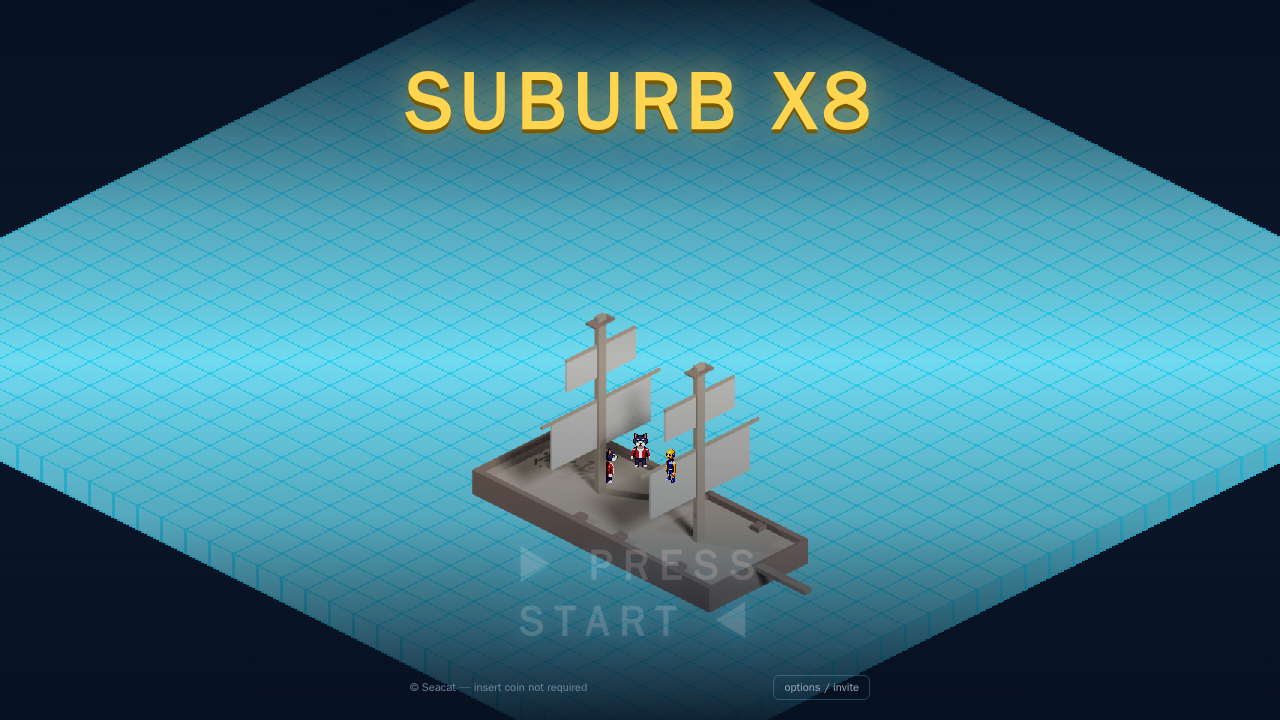
The setup, or: I built a tiny navy
The architecture is sillier than the game. There's a top-level agent I call the Commodore (his name is Halyard, he's very earnest). The Commodore spins up Captains: individual Claude Code sessions living in tmux, each in its own Docker container so they can't step on each other. Work gets tracked in a GitHub issue queue like a real project run by real adults.
Then I spun up an experiment: two Captains with the same spec, one running Fable 5 and one running Opus, and let them race.
Fable 5 vs. Opus: the bake-off
Here is where it got spicy.
The Opus Captain reported back fast. Suspiciously fast. "Done, looks great, QA passed."
The Commodore got suspicious (because it ran so fast) and audited the work. Turns out Opus had "QA'd" the campaign by reading a few dossiers and vibing. The receipts:
- Opus: ~12 minutes of work, 6 dossier reads.
- Fable 5: 38 tool calls, 31 attempts to actually join its own game, and 9 in-game chats. It went in and played the thing.
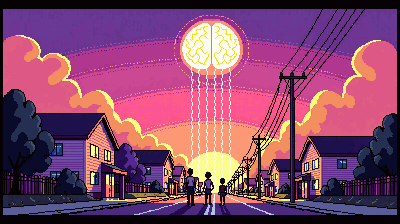 Fable 5's take on the "invasion from above" cutscene: a sunset suburb with a giant brain descending from the heavens. As one does.
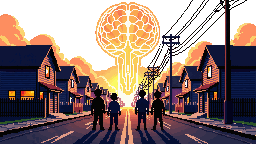 Opus's version of the same brief. It's... there. It exists. It is a scene that is technically present.
Same spec, two very different work ethics. Fable 5 didn't just claim it tested the game. It literally changed the game, and along the way it filed real bugs for other things it found broken. That's the headline finding for me: Fable showed up.
The Good
Once Fable 5 got going, it was genuinely impressive in ways that made me say "huh" out loud at my desk.
- It generates assets. New car sprites, environments, the works. Final tally: 29 sprites and 17 audio clips from the Fable captain (Opus managed 19 and 12).
- It wired up real external tools (PixelLab for sprites, ElevenLabs for audio) and used them without hand-holding.
- It built actual novel features. It implemented cutscenes, which this game had never had in a campaign before. Look at that brain again. Nobody told it to make the brain that good.
- It ran multiple campaign branches in parallel. A whole little A/B fleet, cooking overnight.
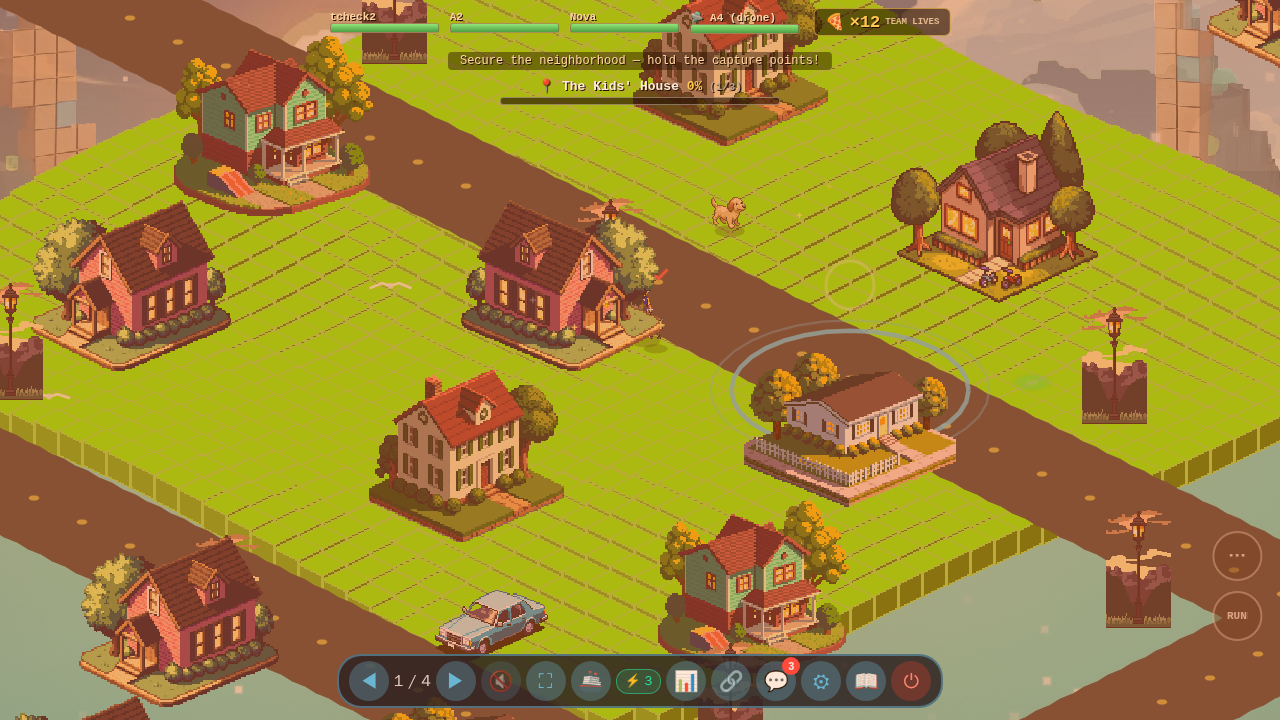
- It scaled the neighborhood 8x: a 900×900 isometric tile map, three bosses (220/260/340 HP), 15 shared lives, escalating wave sizes. And it mostly held together.
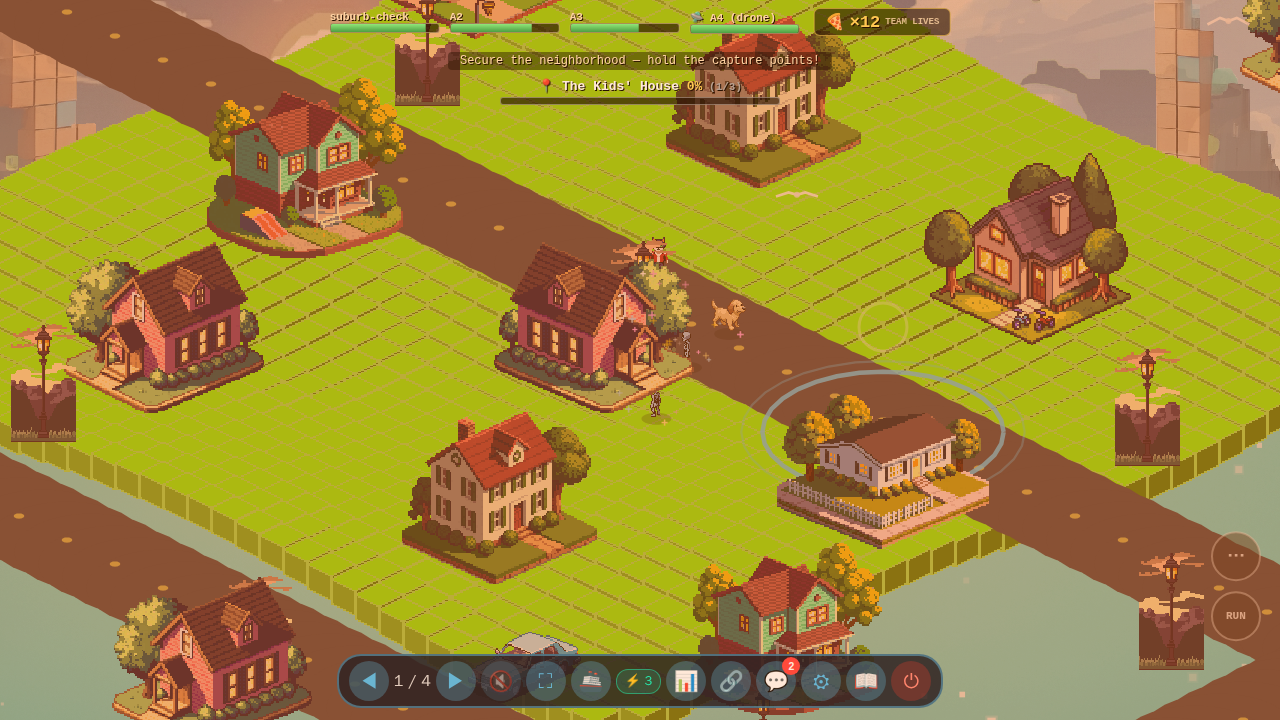 The actual playable 8x suburb, health bars and all. Built overnight while I was asleep.
And it can iterate. Give it feedback ("the dog needs more facing angles," "the water balloon throws the wrong way") and it goes and fixes it, verifies the fix by taking a screenshot of its own game, and reports back. The feedback loop is real, and it is the most exciting part.
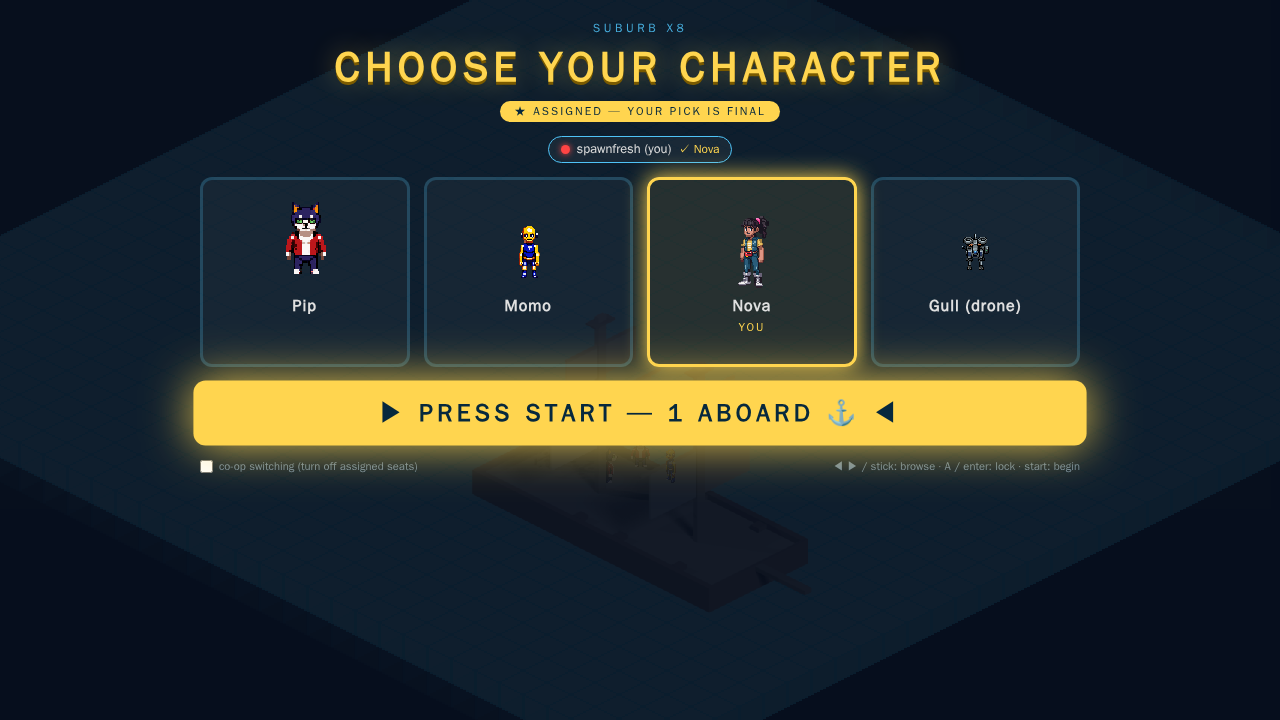 It even built a TMNT-style character-select lobby. That's Pip the cat on the left. I would die for Pip.
The Bad
Now. Let me tell you about the bugs, because they were art.
- Cars spawned and drove sideways, perpendicular to the road, fully committed to the bit.
- Cars also liked to drive beside the road rather than on it, like they were avoiding traffic that didn't exist.
- The ship spawned on land. A seafaring game. The ship. On land.
- Characters got stuck inside buildings, which is a bold interpretation of "open world."
- The big neighborhood's streets didn't line up, giving the suburb a charming "drawn from memory" quality.
- Lasers fired the instant you started walking, then stopped, like the character was sneezing.
- The water balloon threw in the exact opposite direction you aimed. (To be fair, fixing this gave it a satisfying "pull back to throw" feel, so we kept the correct version.)
None of these are dealbreakers. All of them require a human to actually look at the screen and go "no." That's the catch with the whole thing: Fable 5 will confidently build you a world where cars drive sideways and the boat is in a yard, and it genuinely cannot tell that's wrong until you tell it. Quality still rides on the human feedback loop.
The Ugly
Okay. The bill.
I'm on the Max 20 plan, $200/month. In 48 hours, the Fable 5 captain (running flat out overnight, working the queue, with the Commodore unblocking it at 5 AM like a sleep-deprived parent) burned through roughly half of my weekly allocation.
Do the math with me:
- ~50% of a week's tokens in ~2 days of hard work.
- That's about 2 days of agent labor per week at this price.
- For $200/month to feel sustainable, I'd want something closer to 7.
For a hobby side project about a sailing cat, that price point stings. I'm not running a studio. I'm running a tiny navy of robots for fun.
Could it pencil out for a real business? Probably. If an agent is doing genuine work, $1,000-ish a week is a rounding error next to a salary. But for solo developers and hobbyists, the price is the wall you hit first, well before you hit the model's limits.
(It is also, to be clear, a hungry setup. The overnight A/B build thrashed my disk from 75% to 94% over and over (the Playwright screenshot tool alone is a 5.3 GB Docker image), and at one point I over-parallelized and watched free RAM drop to 168 MB with a load average of 83 on 4 cores. No crash. But it made my Mac mini feel really mini.)
Takeaways
- Fable 5 is a real upgrade over Opus for agentic work. When the job is "go do a lot of stuff autonomously and actually check your work," it shows up and grinds. Opus phoned in the playtest; Fable played the game.
- The productivity is real and kind of startling. Assets, features, cutscenes, parallel branches, overnight, unattended.
- Quality still needs a human in the loop. Somebody has to look at the sideways cars. That somebody is me, in my pajamas, at 7 AM.
- The unsolved engineering problem is evaluation. The better a game can automatically judge itself ("is the boat in the water? are the cars on the road?") the more of that 7 AM pajama review the agent can do on its own. That's the frontier.
- Price is the limiter for solo devs. Not the intelligence. The invoice.
Would I do it again? I already am. There's a cat who needs to sail to space, and I am not going to be the one who builds the cloud platforming stage by hand.